Anatomy of a real certificate
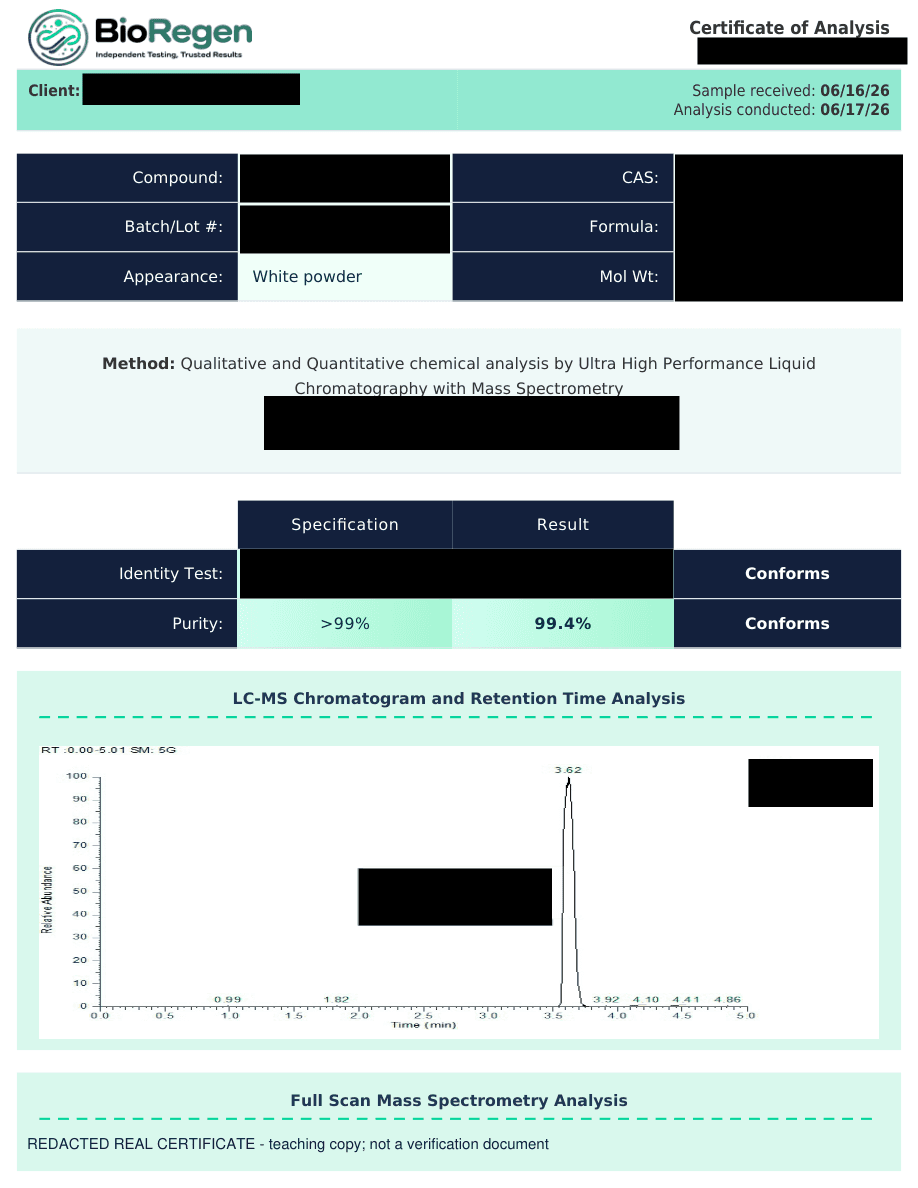
Follow the numbered fields on this redacted first page. The annotations explain where to look; they do not validate the laboratory method or establish the identity, safety or composition of any supplied material.
- Dates
Separate receipt from analysis. Neither date records subsequent storage or handling.
- Sample description
Name, batch and chemistry fields describe the sample on paper. Do not assume they are independent identity findings.
- Stated method
Read what is actually specified. A technique name does not supply missing detector settings or the calculation basis.
- Specification and result
Compare the requirement with the reported observation. “Conforms” applies to the stated test; it is not a general safety conclusion.
- Chromatogram
Use the trace alongside the method. A large peak does not rule out material the method did not separate or detect.
Read across the fields
Compare the sample description, specification and result. Note the method, dates and report identifier. Headers can describe submitted information or a laboratory determination; do not assume which without checking the report or asking the issuer.
- Specification
- The stated requirement or expected result.
- Result
- What the report records for the tested sample. How far that represents a batch depends on sampling and traceability.
- Method and identity
- Check the method actually stated. A matching mass alone does not establish a unique sequence. Do not infer unstated analytical parameters or additional tests.
Example material X
Example material Y
The entries differ. Ask the issuing laboratory to explain the discrepancy; choosing the preferred field does not resolve it.
Entirely invented. No real compound, batch, certificate number, laboratory or conclusion is represented.
Purity is not peptide content
In a conventional UV chromatographic area-percent calculation, the target peak is compared with the integrated signal included by that method. This is not automatically the target compound's percentage of the total powder mass. Detector response, separation and integration all matter.
Chromatographic purity
Target-peak area relative to the integrated areas included in the stated method.
Net peptide content
Peptidic material relative to the sample mass, distinguished from components such as water and counterions. Check the laboratory's definition and assay.
Net peptide content can include peptide-related impurities; it is not automatically the mass of the desired peptide alone. Neither measure by itself establishes fill accuracy, sterility or safety. We do not infer how a particular report calculated purity merely from a technique name.
Supporting reference for the content distinction: Bio-Synthesis: peptide content versus peptide purity. Its explanation distinguishes total peptide from non-peptide components even when multiple peptide species are present. This general reference does not establish the method used in a particular certificate.
A dominant chromatographic peak does not exclude co-eluting or undetected material. Equally, an omitted chromatogram does not by itself invalidate a certificate. If a test is not reported, the document does not tell you whether it was performed or what its result was.
A document check is not a vial check
- Find the published report and compare the whole document, not just its number. Real identifiers can be copied onto altered documents.
- Use the issuer's verification route where available. Investigate differences; a mismatch alone does not establish counterfeiting.
- Check the connection to the supplied material through batch records and traceability. Matching paperwork alone does not establish what a vial contains.
Contact info@southernpacificlabs.com.au with the report identifier, product name and batch marking if you need us to check our records. That is a records check, not new laboratory testing.
Read any report-specific qualifications beside the original certificates. This general guide does not resolve an individual report query.
Further reading
WHO: Model certificate of analysis, TRS 1010, Annex 4 (2018), pages 187–189. A general model covering sample information, tests, acceptance criteria and relevant sampling details. Its format is not prescriptive. This reference does not imply WHO endorsement or establish that an individual certificate complies with the model.
Bachem: peptide purity and net peptide content. A manufacturer's technical explanation, not evidence of the parameters used for our reports.
Reading research · Evidence standards · Certificate register
Revision note, 27 September 2026: reading map v1.1 adds on-sheet references and clearer wording about identity and document checks. Technical review remains pending; this is an editorial revision, not scientific sign-off.